Demon or Deity · Chapter 5
Empathy In A Time of War
By Kalyan Varma
Demon or Deity · Chapter 5
By Kalyan Varma
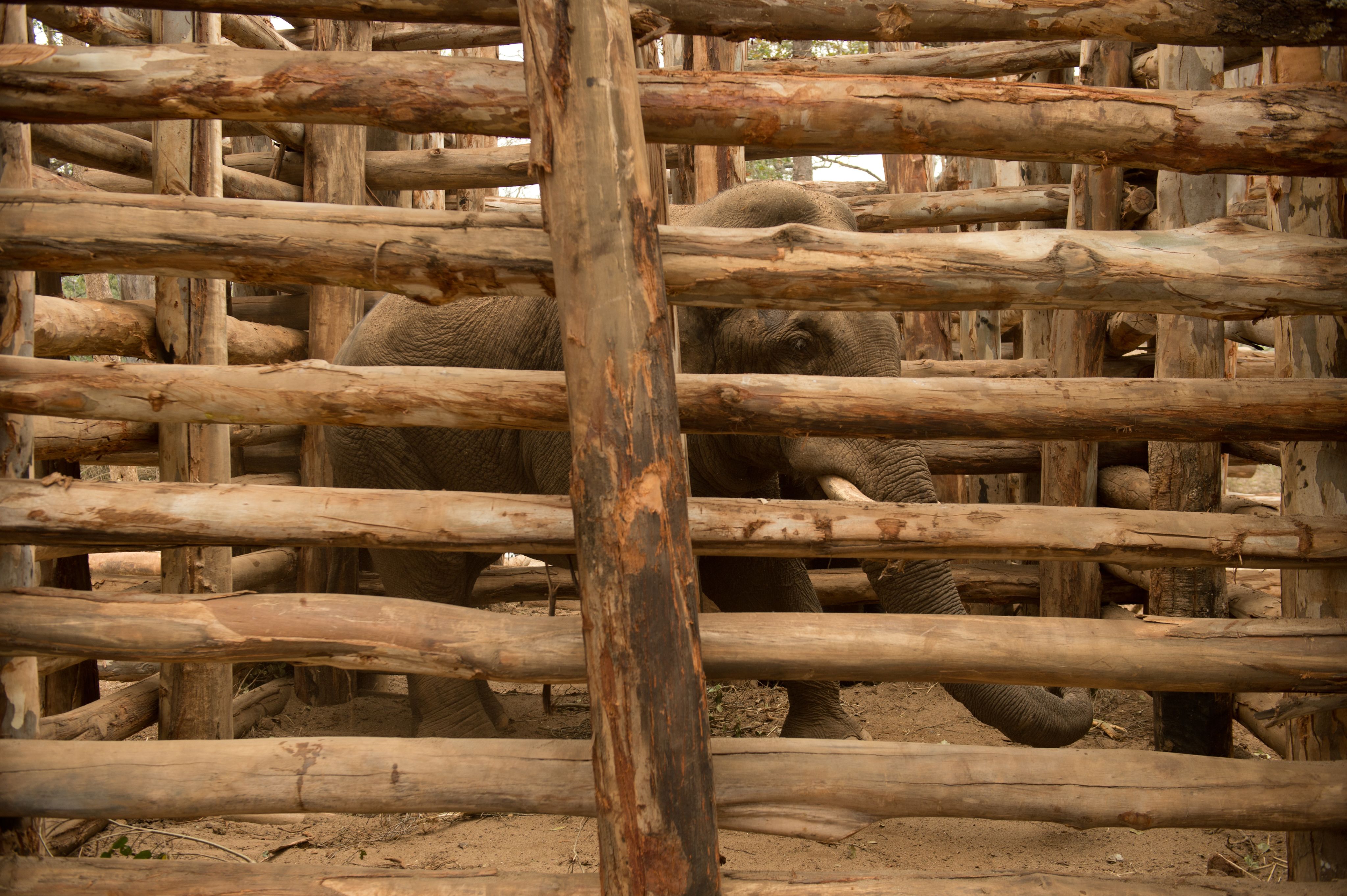
Five tame elephants and a wild tusker clash in a battle of wills and strength. And yet, in the midst of that primal scene, the tame elephants and the wild one interact in moments of heart-stopping empathy.
"Where the hell are the elephants?" Chittiappa was furious, and Venkatesh the forest guard wilted under his onslaught. Venkatesh was reputed the best tracker in the region but, for all his skill, he hadn't managed to locate a single elephant. "Just last week they were everywhere," the 58-year-old veterinarian told me, the milder pitch of his voice not masking his frustration. "They were destroying crops here, there, everywhere, we kept getting reports. So here we are now, and not a single one of them to be seen…"
It wasn't what I wanted to hear. Ten days earlier, I had dropped in on Mr Vinay Luthra, Chief Wildlife Warden for Karnataka, at his office. In course of conversation, Luthra mentioned that the court-mandated capture of the elephants of Hassan would begin in a few days. Luthra asked me to film the operation on behalf of the forest department, and suggested that I get to Hassan as soon as possible. I dumped my gear in the car and hit the road. Just outside Mysore, I spotted a truck parked by a roadside chai stall. On it, swaying gently to the beat of some internal rhythm only he could hear, was an elephant. Arjuna had to travel over 200 km from BR Hills to Hassan to participate in the elephant capture operation. Over chai, I discovered that the elephant was Arjuna, residential address BR Hills. He was being transported to Hassan for the capture operation.
In Hassan the mood was a mixture of the angry and the festive. A day earlier, a farmer had been trampled to death by a wild elephant. The locals, roused to renewed fury by this latest tragedy, had vented their anger on Forest Officer K Devraj, who had visited the location in response to a report and was beaten up for his pains. News of the impending capture had gotten out, however, and the scene was now festive, with local media, villagers, forest department staff, trackers, vets and assorted hangers-on gathered around.
Arjuna arrived in due course and took his place alongside the other nine tame elephants, the 'Kumkis', who had been brought down to Hassan: Jayaprakesh, Bhima, Drona, Gajendra, Abhimanyu, Srirama, Balarama, Tungabhadra, Harsha and Arjuna.
Venkatesh, the ace tracker, had put together a photo album of all elephants known to be in the area. Copies were passed around to the trackers. One tusker, known to be the largest and most aggressive, was singled out for special mention as a prime target. The Kumkis and their mahouts set out on the trail. Jeeps loaded with vets and trackers took off into the forest, only to return empty-handed after a long, hot, exhausting day.
"I think I know what is happening," Vasanta, the veteran mahout, said. Everyone crowded around to listen. "Our Kumkis are warning the wild elephants," he said. Elephants use infrasonic frequencies, too low for human ears, to communicate over great distances. That is what the Kumkis are doing, Vasantha said — elephants are intelligent, our Kumkis know there is harm intended and they are sending out warnings, telling the wild ones to stay away.
There seemed to be something to Vasanta's theory. How else explain why over 30 wild elephants that had been around in the area till just the other day had vanished as soon as the Kumkis arrived? The conversation shifted to practicalities. There is no way to mute an elephant, no way to prevent the tame ones from transmitting their warning signals. It was decided to bring in more trackers, and to widen the radius of the search.
Four days later, Chittiappa called. The team had finally captured a Makhna, a male without tusks. I rushed back to Hassan. The Makhna, roped to a tree near the camp, looked confused and angry. Around five that evening, we got a call reporting the sighting of a tusker in a nearby forest. We rushed over and caught up with the trackers. The sharp-shooters loaded up and slipped into the forest, following the trackers till they came upon the elephant. One of them took the shot, hitting the elephant with a dart loaded with Immobilon, a tranquilizer that relaxes the muscles. The dosage has to be precisely calibrated to the size of the elephant – too large a dose and the elephant will never wake up again; too small a dose and the elephant won't be sufficiently stunned to effect the capture.
The few minutes immediately following the immobilization are highly critical. In that span of time, the tame elephants are rushed to the spot. Forest officials and mahouts rope the immobilized captive, one rope to each leg and one around its neck. The other ends of the ropes are fastened to the tame Kumkis. While the forest staff race through this process, the vets take the elephant's vital signs and cut off the sharp points of the tusks. The downed elephant is then revived with the injection of the antidote drug Diprenorphine (trade name Revivon), which again has to be administered in a precisely calibrated dosage.
Abhimanyu was the lead Kumki on this capture. He was known through the state as much for his strength as for his vile temper; Vasanta, the mahout, was the only one who could control him. A long, thick rope connected Abhimanyu to the captive. The mighty Kumki braced its legs, took the slack, and began to heave. Meter by meter, it dragged the captive through the forest.
Evening extended into night. The headlamps of the official jeeps lit up the forest, freezing the scene in a cloud of dust. The shouted instructions of the mahouts and officials, the excited chatter and press of the crowd, the occasional thrum of a rope stretched suddenly taut, and the angry trumpeting of the captive combined in a scene from hell. It took an hour before the captive was finally hauled out of the forest and into an open area adjoining the backwaters of the Hemavati river.
The progress, foot by painful foot, continued for another kilometer, and then the captive stopped dead in his tracks. Despite the urging of their mahouts, the Kumkis refused to budge. The five tame elephants stood stock still. In their midst stood the immobile captive – a surreal tableau lit in the golden glow of the headlights and torches.
Just when it seemed the impasse would last for the rest of the night, Abhimanyu went over to the captive and took up position beside him, the bodies of the two mighty tuskers almost touching. Long minutes later, Abhimanyu lifted his trunk and reached out, caressing the captive in a gentle sweeping motion from the forehead on down. As the Kumki's trunk swept down, the captive opened its mouth. Abhimanyu slid his trunk into the open mouth and thus they stood, frozen in solidarity.
The captive calmed down, a calm so palpable that it radiated outwards from where he stood in Abhimanyu's sheltering hug and enveloped the rest of us — Kumkis, officers, mahouts, vets, the watching crowd, and me.
It was the night of February 18, 2014. As this scene played out in Hassan, elsewhere in the world a group of researchers published a paper in which they recorded this exact phenomenon, which they characterized as 'consolation behaviour'. The research, published jointly by lead scientist Joshua Plotnik of Mahidol University in Thailand and premier primatologist Frans de Waal of Emory University, comprehensively charts such behaviour.
"The 'trunk in the mouth' gesture is the elephant equivalent of a handshake or hug. It's a very vulnerable position to put yourself in, because you could get bitten," Dr Plotnik told the Daily Mail. "It may be sending a signal of 'I'm here to help you, not hurt you'."
This is what I witnessed in person that day, with one added nuance: here was a tame elephant consoling a wild one it was helping to capture, rather like a cop giving a criminal an empathetic hug even as he put the handcuffs on him. It was a conflict zone, almost a war, out there — and yet, even in the midst of that titanic struggle there was this moment of empathy, an instant of fellow feeling, that made my eyes mist.
Just when we thought order had been restored, the captive collapsed, landing on the ground with a dust-raising thud. It was hot — nearly 40°C, with high humidity. The vets put the collapse down to a combination of heat, the lingering effects of the tranquilizer, and the debilitating effects of his own hyper-ventilating efforts to free himself. Forest guards ran over to a nearby stream to fetch water, which they poured over the captive to cool its heated body down.
Surprisingly, even the locals, who till then had greeted the capture with vengeful cheering, seemed to undergo a collective change in mood. The untamed spirit of the wild one had won them over; the crowd seemed to be willing it to get back on its feet. The mahouts tried to get the Kumkis to boost the captive back on its feet, but the elephants refused their urging. Instead, two of them walked over to the prostrate captive and caressed him with their trunks. They touched his ears and eyes, and tried to open his mouth and push their trunks in.
Suddenly, the captive lifted his head, strong and proud. It was as if the Kumkis had said something to him, something gentle and calming and consoling, and he was responding. Abhimanyu walked over and gave the captive a little nudge. On cue, he struggled back onto his feet and, with trunk raised in defiance, split the hush with a resounding trumpet blast. The crowd erupted in cheers.
A captured female had been brought out of the forest, and was roped to a banyan tree near the camp. Forest Department officers requested a biologist from World Wildlife Fund to collar the female before releasing her. The thinking was that the female would find its way back to its own herd and therefore, by tracking her, the officers could identify the whole family group and capture it en masse.
As we waited for the collar to arrive, a Kumki named Srirama went up to the captive female and took up station at her side. We watched in wonder as Srirama gently touched the captive female with his trunk, then wrapped it around her face and held her in an embrace. Under the shadow of Srirama's empathetic presence, the captive female grew visibly calmer and less stressed.
Bomma, the mahout, gave me a clue to Srirama's behaviour. "Srirama was captured right here in Hassan, in 2009," he said. That was when the penny dropped. "They might have known each other before?" I asked. "Most likely," Bomma said. "They are both adults, and since he was captured in this same area, they could very well be related, maybe even cousins."
Srirama remained by the captive's side through the night. And when the captive had not eaten anything since her captivity, Bomma made big balls of paddy mixed with straw. Srirama ate a few mouthfuls and on his own, he picked up a ball of the food with his trunk and fed it directly into the captive's mouth.
Throughout the night, Abhimanyu was the one who had to take the maximum strain; it was his strength that had been harnessed to dragging the captive through the forest and to the truck. He was tiring, bleeding near one of his tusks. And yet, in the midst of this struggle, his empathy for the captive never flagged. Each time Vasanta urged him to head-butt the captive, he instead walked up and twirled his trunk around that of the wild one. He would hold the pose for a few moments. Those of us watching understood, without words. "Sorry," Abhimanyu seemed to be telling the captive. "I'm sorry, but I have to do this to you." And then he would back off, charge forward again, and butt the captive another foot backwards onto the bed of the truck.