Shepherds & Grasslands · Chapter 2
Life on the Move
By Kalyan Varma
Shepherds & Grasslands · Chapter 2
By Kalyan Varma
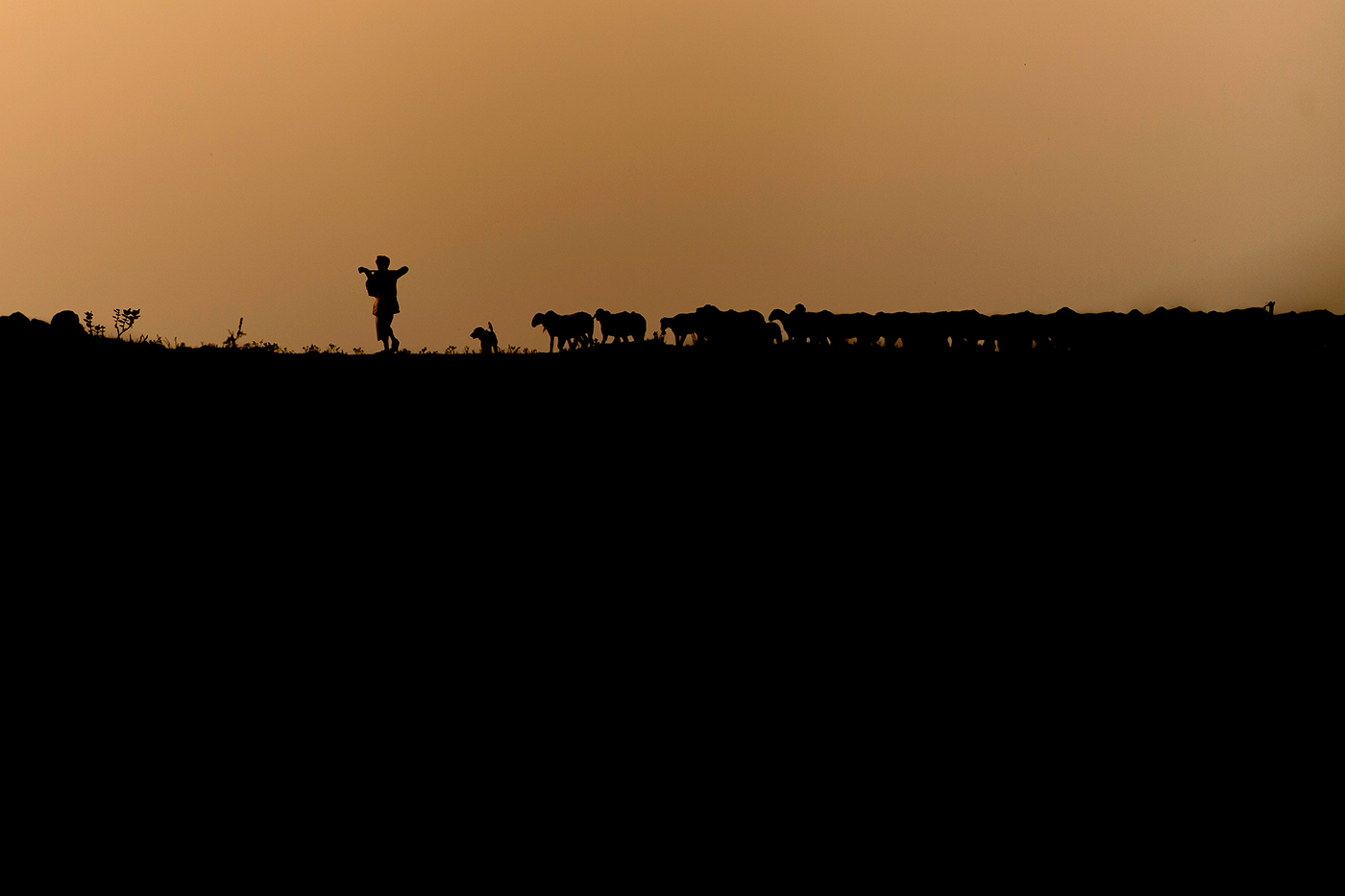
The Dhangars are always on the move and, twice a year, they make a 500 km long migration across central India. This is the story of their journey.
The sun rose bright and fiery, its heat radiating off the vast plains surrounding us.
The somnolent atmosphere of just the day before transformed into one of furious activity.
The people came from everywhere — traders, farmers, butchers, army officers… a democratic gathering with a single purpose: to celebrate the imminent march of the Dhangars, the last of India's truly nomadic tribes.
Sheep are the lifeblood of the pastoralists; in their growing numbers lies economic security. Yet, on that day, lambs were being slaughtered with seeming unconcern. For every dozen visitors who trickled in, a fresh lamb was pulled from the pen and butchered.
The acrid stench of blood hung thick, mixing with the tang of cooking curry and the sharp smell of wood-smoke from the many fires that burned under the cooking pots.
The Dhangar men greeted their guests and made small talk; the women bustled around in a swirl of chatter as they tended to their pots. Sheep bleated their alarm at the smell of the blood of their own; every now and again, a horse neighed its protest at the tumult contrary to the peace of pastoral existence.
The feast began in the early afternoon. Vast quantities of mutton curry and rice were consumed amid a cacophony of conversation and convivial laughter. The guests, all from different strata of society, were united in rapport with the nomads, who they would not see for the next six to seven months — until the monsoons arrived.
It was very late into the afternoon before the guests took their leave to a chorus of final farewells and promises to meet again soon. And then the Dhangars got down to the real business of the day.
The tribe's elderly priest, who with his assistant had arrived earlier in the day, created a small shrine for the three godheads of the nomads: fresh-cut grass, a horse, and a dog — the trimurti the nomads rely on for their survival and that of their sheep.
As the sun eased down to the western horizon, a small fire was built and stoked to red heat. Gowri, the wife of Mahendra Kathal, leader of this clan of Dhangars, stepped forward to take the oath on behalf of the women of the tribe. Without a flinch and to the chant of the priest and the beat of the drum, she walked through the fire and vowed that she would always be there to look after her family, who in turn would care for their sheep. She also made a promise to the deities — to plant a neem tree and look after the water sources.
It was a strange mood in the Dhangar camp — not joy, not sorrow, for none knew what the days ahead would bring. It was a mood of acceptance of the certainty that change would come with the morning.
More drums were brought out, and passed around among some of the Dhangar men. The rest — men, women, children — gathered in ordained formation. And then, to herald the change that was now upon them, they danced the steps that mark the beginning and the end of each chapter of their migration.
It was late in the evening of the previous day when I reached the Dhawalpuri grasslands after a pleasant three-hour drive due west from Pune city and across the heart of Maharashtra. The setting sun had bathed the vast grassland in orange tints as I reached the Dhangars' monsoon campsite.
Mahendra Kathal, who I had first met two years ago and with whom I had since become good friends, greeted me with a warm smile and tight hug. We went into his hut and caught up over tea, thick with milk and sugar, served in battered steel tumblers.
It was two weeks after Diwali. The festival is the usual cue for Dhangars to pack and migrate towards their summer home in the west, close to the Konkan coast. But 2014 had witnessed unusually heavy late monsoon rains followed by Cyclone Hudhud; this had resulted in fresh growth of grass. The Dhangar migratory cycle is predicated on availability of good grazing for their sheep. The fact that this monsoon cycle was more than usually rich prompted Mahendra to stay back rather than risk the unknowns the annual journey was fraught with.
That extended time had run its course. The Dhangars were now ready to march to their summer home amid the rich pastures a few hundred kilometers away, across the Deccan plateau.
We didn't sleep a wink that night.
The sickly-sweet stench of blood from the slaughter of the feast still hung in the air, a magnet for hyenas and wolves whose proximity prodded the guard dogs into a frenzy of barking that lasted through the night. The predators failed to catch any of Mahendra's penned-in sheep, but did sneak away with two lambs from a neighbouring pen.
The teeth-jarring screech of dozens of chickens finally made me give up my attempts to doze. The Dhangars migrate with a complete menagerie: sheep, goats, horses, dogs, chicken… For five months now, the chicken had roosted comfortably in one place. They were in no mood to be caught and shut into their cane baskets — a task four grown men and six little children were engaged in when I wandered out of the hut — and were registering their protests at ear-splitting volume.
The horse is key to life on the road. The packed belongings of the community are a hefty load that is distributed among them. Additionally, the young lambs, which have already been separated from the main flock in preparation, will hitch rides on their backs. The health of the lambs is key to the Dhangar fortunes; making them walk long distances is therefore not a good idea.
Mahendra made the rounds of his livestock. To me, observing from a distance, it seemed like he knew every individual member of the flock personally — which one was limping, which hadn't been eating well, which one was fighting with which and therefore needed to be kept apart, which one hadn't drunk sufficient water… His smooth efficiency made me think of an Air Traffic Control station — here was the same combination of positional awareness of the whole coupled with granular awareness of each independent component.
By early afternoon, the men had brunched and set out on the trail with their flock of sheep. It was up to the women to clean up camp, complete the final packing, load the horses, and set off for the designated night camp.
What does it take to pack all your belongings, after staying put in one place for five months? What does it mean to unpack everything at the end of each day, repack it all the next morning, and keep up this punishing schedule for the next thirty days, maybe more?
"People think we are a jobless bunch, just hanging around all day with our sheep, doing nothing," Mahendra said. "Come, let me show you what it takes."
We trekked up to the ridge of the hill and then walked along the contours of the plateau. He never seemed to want to sit, to rest, to catch his breath — he kept up a steady pace, just right to keep the herd moving forward, while giving the sheep time to graze and to drink water at need.
They migrate twice a year — in November, to their winter and summer home near the Konkan Coast; for the monsoons, the same route in reverse. The patterns and pauses of the march are ingrained in him and his fellows: when to set out, what pace to set, where the next suitable campsite is…
The needs of the flock determine the route. There has to be sufficient grass for the sheep to graze. There has to be at least two natural water sources between one camp and the next. The pace of the march is calibrated to reach the first water body by noon.
Mahendra's trusty black guard dog 'Kaalu' walked beside us. He cannot fight off the wolves that stalk the trail; his job is that of a canine early warning system. Just past noon, Mahendra noticed a pack of six wolves on the horizon. He ran towards them with his slingshot (gophan). The wolves looked fat, healthy, and well-fed. That, he explained later, was because of all the sheep around. Once the Dhangars had migrated out, food would become scarce and the wolves would become thin again.
By 4 in the afternoon I was exhausted — the heat, the humidity, the steady march, had taken their toll. I had not eaten since the morning and was hungry, and I was running out of water. Mahendra laughed at my discomfort. Two more hours to go, he told me. We walked on.
Around 6 pm, right on schedule, we reached the edge of the Dhawalpuri grasslands. The women and the horses bearing the community's belongings arrived half an hour later. The young lambs were unloaded from the horses and reunited with their mothers.
There is a romance about grass. Running on grass, bare feet reveling in the feel of soft turf, toes involuntarily curling to the tickle, the damp of dew adding a layer of pleasant sensation… it's a romance that feeds on nostalgia.
It's a wonderful feeling — until you actually have to do it. I had been at it for a week, trekking through grasslands alongside the Dhangars, and thinking with each successive day that 'romance' was not what I felt underfoot. Under the deceptive softness of the grass, sharp-edged rocks shredded my footwear. Thorny shrub and the razorlike blades of mature grass slit the soles of my feet — a thousand blades inflicting a thousand cuts that seared and bled.
A Dhangar walks on average 15 km every day, most of it on grass and rock. That is over 5,000 km a year. There is in Dhawalpuri village a cobbler who understands these needs and specializes in footwear for the nomads. He makes chappals able to withstand the rigors of walking in all kinds of conditions — "Dhawalpuri Chappals."
The base is fashioned from the hide of cows. The sole is made of rubber salvaged from old airplane tyres. The straps are of leather from the buffalo. A pair weighs around three kilos. I tried one on. It felt like my feet were encased in lead. I have no idea how they manage to walk — with easy grace, for long periods at a stretch — in those. The ones Bapu, Mahendra's brother, had on were over two years old. With some nails to hold its various layers together, he said, they would serve him for another year.
The Dhawalpuri grasslands is in the heart of the Deccan plateau. As it is leeward of the Western Ghats, very little precipitation reaches this area, making it among the hottest and driest places in India outside the deserts of Rajasthan.
For the nomadic Dhangars, access to water is the key to their journey. Their only access is the few seasonal streams, scattered village wells and the odd irrigation canal. The children are usually entrusted with the task of scouting for water. They find natural sources, or sometimes depend on a bore-well, or irrigation pump, or even little pockets of seepage. They collect this water and cart it back to camp, where it is boiled and stored for use.
Around noon we reached a stream. The goats and sheep lapped up the water, but Mahendra told me it was not fit for us to drink as it flowed downstream from a village. We marched on for another couple of hours and reached another stream. Mahendra walked for another half kilometer or so, till he came to a rock overhang under which the stream seemed to originate. He stretched himself prone on the ground, lowered his face to the water, and drank. He needed neither utensils nor even cupped hands.
On a whim, I followed his example, lay flat on the rock and lapped at the water. It was the sweetest I have ever tasted.
Nomadic life is a gamble, a daily wager that you can predict the unpredictable and trump the unforeseen.
The Dhangars don't move en masse. They are broken up into small groups, each bound together by familial ties. While Mahendra's group decides to stay put, another might decide to march on, sticking to the normal migratory route and timing.
Early the next morning, Mahendra got a call. It was from Gopal, the leader of another group. Gopal's group had decided to stick to the normal pattern, crossing the Western Ghats and nearing their final destination near the Konkan coastline. The area had not received the usual amount of rain, Gopal warned Mahendra. The land was dry and grass was sparse.
Gopal and his companions had gambled, and they had lost. Mahendra had bet against the odds when he decided to stay back, and he had won.
"We will stay in this area for now," he told his group that day.
My time with the Dhangars had come to a temporary end. I had joined them with some notion of doing an experiential story and, in the process, learning what it took to handle a few thousand sheep on a long trek.
I left with much more — with a granular understanding of the complex inter-relationships that linked the shepherd and his sheep, the sheep and the grasslands, and all of that with the predators that call the region home.
I listened to Mahendra and his brother Bapu plan their next moves, and realized I was eavesdropping on tribal wisdom accumulated over a thousand years.
I left anticipating the shower I'd take when I finally got home — a short one, in honour of the Dhangars and of the water that is their sole lifeline.